The three Task Forces with the mission to drive us towards the Three Zeroes
The Leprosy Mission has commissioned three Task Forces that are aimed at driving us towards the goals we have set ourselves for the Three Zeroes: Transmission, Disability, and Discrimination. These Task Forces have been established so that we can drive the organisation towards the goals outlined under the Three Zeroes in our Global Strategy 2025-2030. There is also an additional Task Force looking at fundraising.
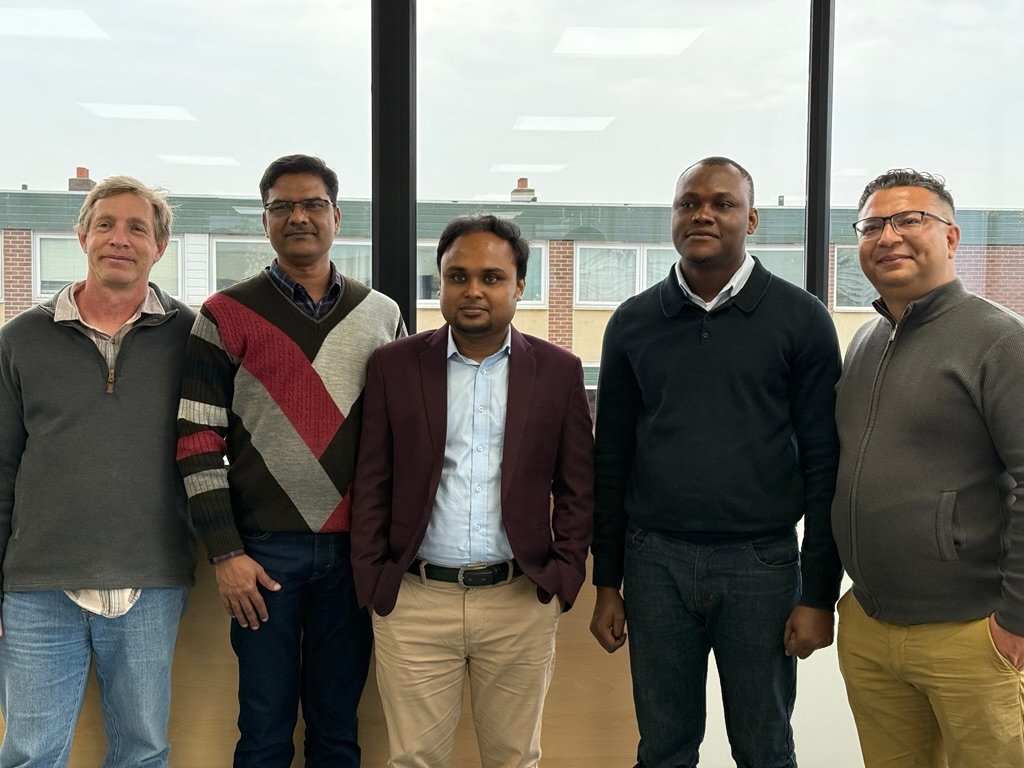
In this article, we want you to see exactly how these Three-Zero Task Forces are planning to achieve change and the ways in which they will be looking to partner across the leprosy sector. We spoke with the convenors of each Task Force: Dr Jivan Shakya, Dr Indra Napit, and Peter Waddup.
Making the most of diagnostics and PEPOur Task Force is aimed at reducing the transmission of leprosy in TLM’s countries. Our plan is to do this through a focus on diagnostic tests and PEP.
In most cases, ongoing transmission in a community is happening because of late diagnosis and we believe this is because there is no proper diagnostic test available in most countries. We have interviewed countries across The Leprosy Mission and found that many are still relying on the clinical diagnosis offered by a healthcare professional inspecting skin patches, which places a big burden on very limited human resources; it is no surprise that we struggle to find all the cases of leprosy in our districts. So, one of our two focuses is on identifying a diagnostic test (or tests) that could be implemented across our countries.
We also know that, in the absence of a vaccine, the most effective way of preventing leprosy is through post-exposure prophylaxis (PEP). By offering a single dose of the antibiotic rifampicin to people at risk of leprosy, we can significantly cut the chances that they will contract the disease. Our Task Force is looking to identify the best methods of implementing PEP. We know the costs can be quite high and that there are some mixed feelings about PEP. We want to identify how we can overcome these hurdles and take advantage of a golden opportunity to prevent leprosy transmission.
Making diagnostics and PEP a routine fact of leprosy work
With so many countries relying on clinical diagnosis of leprosy, an easy-to-use, field-friendly diagnostic test could prove transformative.
We want to identify and recommend a test that could be used without much technical experience, so that even volunteers with limited technical knowledge can imeplement these tests in the field. We haven’t yet identified that test and we recognise that we may need different tests to identify MB and PB leprosy, likely one that is a simple PCR test and one that will measure immune response to bacteria.
Our goal for PEP is a little different. There are already a number of ILEP members who are actively working on PEP. To support long-term change, we will need to partner with those ILEP members and facilitate the logistics for effective PEP implementation.
Further, faster, better
Success for our Task Force will be when we have effective, easy-to-use diagnostic tests at all of TLM’s field sites so that we can identify cases at a very early stage. This will require the involvement of TLM staff, volunteers, and government health staff.
For PEP, success will mean implementing PEP over a wider catchment area. That will require coordination with ILEP partners and with government National Leprosy Programmes.
We want to see both the diagnostic tests and PEP implemented across all areas of the countries we work in, but we don’t work in all areas of these countries, so we will focus at first on the districts where TLM teams are present.
We will be investing in research
One of our objectives is to support the research being carried out around diagnostics and PEP. We’re looking into the newer diagnostic tests and different regimens for PEP. We will review the papers that already exist and then we will invest in the research that looks most promising. For example, if a promising diagnostic test is looking to achieve field validation, we’ll invest in that. We will identify one or two that could work.
Providing the best care to reaction patients
In the Disability Task Force, we are focusing our efforts on providing care for reaction patients – both type one and type two. Reactions affect around 30 percent of leprosy patients and TLM needs regularly updated and contextualised guidelines to meet our country’s needs in alignment with national and global guidelines.
The WHO guidelines on reaction management need updating with new treatment options that have become available. We also know that a number of the treatment recommendations within the WHO guidelines are not available in some of our more low-resource settings. We want to compare and find potential gaps to improve practice by comparing with the gold standard guidelines from ILEP, WHO and international textbook of leprosy.
Our hope is that we will be able to define the best possible set of updated recent treatment guidelines for reaction patients which can be used in both high- and low-resource settings.
Three routes to achieving change for reaction patients
Our Task Force has developed three work packages that are aimed to achieve long-term change.
The first work package is a review of the reaction management guidelines from the WHO, ILEP, and International Textbook on Leprosy. Our aim here is to identify the gold standard guidelines. We will then compare the national guidelines across the 12 TLM countries to identify gaps that need addressing.
The second work package is a scoping review of reaction prevention and management. We have collected more than 4,000 articles and we reviewing this literature to identify recommendations that are most relevant to TLM and which drugs would be the best for our hospitals to use.
The third work package is qualitative research. We are interviewing reaction patients and the medical staff who are responsible for reaction patients across TLM. We want to understand what is lacking, what the gaps are in treatment logistics, and what the gaps are in our knowledge and operations.
Through these three work packages, we will have recommendations ready by the end of 2026 which are aimed at creating long-term change for reaction patients, both in terms of their physical care and the mental health.
Clarity for reaction management
Our three work packages are going to produce recommendations for the management of reactions within TLM. Providing this clarity for our teams will hopefully lead to better outcomes for our patients.
From 2027: Beyond that, these recommendations are going to feed into clinical trials that we will run from 2027 onwards, seeking to provide the evidence-base for our recommendations so that they can be implemented across the world, both inside and outside TLM.
From 2029: Our efforts will be focused on developing training materials and conducting advocacy with government health services so that the best approaches to reaction management will be followed worldwide. Ultimately, success will mean reaction patients in all countries get the best treatments and the best management that is available.
There are big improvements that we can capitalise on
There are newer treatment options for reactions that are not being well-utilised across the world and we need to change that. But we also know that there is a big gap in the psychological and social support that is offered to reaction patients. We could take big strides forward is we improve that area of our care.
We want an integrated approach to reaction care, not just providing drugs. We want to improve our social and psychological care and make better referrals for rehabilitation, especially if joints or neuritis are involved, which can lead to impairments.
Securing and growing the inclusion of persons affected by leprosy
Initially, our Task Force was the ‘Discrimination Task Force’ but we added a word very early on to be the ‘Discrimination/Inclusion Task Force’. Under our Global Strategy 2025-2030, our discrimination focus is really a question of how we can best include Organisations of Persons Affected by Leprosy (OPLs) and persons affected by leprosy within our work. So, inclusion is the word at the forefront of all of our plans.
Our aim is to include persons affected by leprosy more prominently in our work, allowing them to heavily influence our decision making and, ultimately, our next Global Strategy.
Increasing the capacity of OPLs
There are few more promising ways of creating the potential for long-term change for persons affected by leprosy than investing in OPLs.
To create long-term, lasting change, we will ensure that OPLs have the capacity and the voice that will allow them to be influential. More than that, we want that voice and influence to be something that we share as we work more closely together.
We have started this process with a series of interviews throughout 2025. These interviews have been with TLM’s countries and with the OPLs in our countries, as well as a few OPLs that are not in TLM countries. We don’t yet have all the answers for how to achieve long-term change, but we will likely begin to find those answers when we review those interviews in January 2026.
The encouraging thing is that our starting point is much better than we thought. Many TLM teams are already heavily invested in their local OPLs and in many countries we have employed persons affected by leprosy who are influencing our work from within. One of our goals for 2030 might have been to see OPLs having a voice at government level, but we are excited to see that is already happening in some of our countries. That’s really positive, but it means that some of the low-hanging fruit is not available to us as a Task Force. We’ll have to reach higher and push ourselves to the next level – it’s a challenge we will relish.
Success means the approval of OPLs
It is not really for us to define what success means. It is up to OPLs and persons affected by leprosy to tell us what they think success would look like.
Some of the early findings from our conversations with OPL leaders has shown us that there is dissatisfaction with the wider leprosy sector. We have heard that the over-emphasis on the ‘three zeroes’ terminology has taken away the limelight from the real needs that persons affected by leprosy are facing today, such as drug shortages or a lack of voice at the government level. Their voices are not being heard in the big-picture discussions
Success will mean those voices are heard more thoroughly and that’s certainly what we’ll aim to do as a Task Force; we will keep checking with OPLs to see if they are happy with our plans. If they are happy, that will be an important indicator of success.
We won’t achieve this on our own
A Task Force of five people cannot bring about all of this change on our own. We will need the buy-in of TLM globally, and to partner with OPL leaders and ILEP partners.
We have already made a promising start through a developing partnership with the Sasakawa Health Foundation, who have done amazing work on supporting OPLs, including hosting the three Global Forums of OPLs. We have met with the Sasakwa senior team and have started working together on supporting persons affected by leprosy in Sri Lanka and on developing Papua New Guinea’s first OPL.
Through partnerships, we want to saturate the leprosy world with the importance and need for inclusion of persons affected by leprosy.
Effective diagnostic tests need to be in the hands of field teams across the world if we are to interrupt leprosy transmission and the most effective way to prevent transmission right now is PEP, so we must invest in how to implement PEP well in a variety of contexts.
New treatment options have changed the map on reaction care and a new set of guidelines needs to be developed to reflect both that new reality and the fact that reaction care should be holistic, caring for the whole person.
The fight to defeat leprosy will be stronger when OPLs have the capacity and opportunities to make a difference, so we will invest in their capacity development and share our influence with them.